 floridafiresafety.org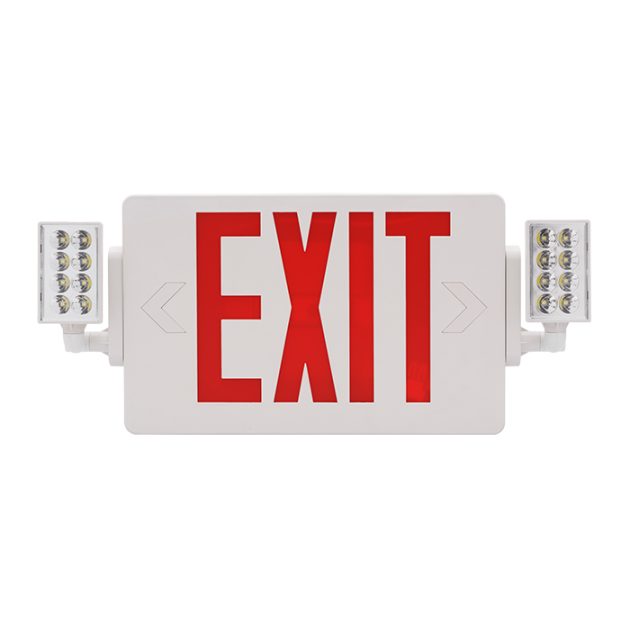
What this section covers
Emergency and exit lighting is a life-safety system, not a decoration. When the power goes out during a fire or emergency, these lights are what allows occupants to find the exits and get out safely. They're required in virtually every commercial occupancy in the United States, and Florida fire marshals check them at every inspection.
This section mirrors what we cover for fire extinguishers — a full breakdown of types, compliance rules, costs, and a self-audit checklist you can use the week before an inspection.
Light Types by Industry
Exit signs, emergency lighting units, combo fixtures, photoluminescent, and central battery systems — which type each occupancy actually needs and how to specify them correctly.
See Light Types by Industry →Compliance Requirements
NFPA 101, OSHA 1910.37, the International Fire Code, and Florida amendments — the placement rules, illumination levels, battery backup duration, and testing cadence your inspector will verify.
See Compliance Details →Cost & ROI
Unit costs, installation, battery replacement cycles, and the real savings from switching to LED. What a fair service quote looks like in Lake County and Orange County.
See Cost Breakdown →Self-Audit Checklist
The monthly 30-second test, the annual 90-minute test, and every physical inspection item your fire marshal will check. Print and walk your space before the inspector does.
Run the Checklist →Exit signs vs. emergency lighting — what's the difference?
These are two distinct life-safety systems that work together. Many business owners treat them as the same thing, which leads to gaps that fail inspections.
Exit Signs
Illuminated signs (usually red or green lettering on white or green background) that mark the location of exits and exit paths. Their job is directional — to tell occupants where to go.
NFPA 101 and the International Building Code require them above every exit door and at every point along an egress path where the direction to the exit might not be obvious. They must be visible from any point along the exit access corridor.
Key requirement: Illuminated at all times during occupancy, with battery backup capable of 90 minutes of operation during a power failure.
Emergency Lighting Units
Fixtures that provide illumination of the egress path itself when normal power fails. Their job is visibility — to make sure occupants can see where they're walking as they exit.
NFPA 101 requires a minimum of 1 foot-candle of illumination at the floor level along the exit access path, dropping to a minimum of 0.1 foot-candle after the first hour of emergency operation. They must activate automatically within 10 seconds of a power failure.
Key requirement: 90-minute battery backup, automatic activation, and specific illumination levels measured at the floor.
Why does this fail inspection so often?
Emergency and exit lights are unique among fire safety equipment because they can fail completely without any visible warning. A fire extinguisher with a dead gauge shows a red indicator. A sprinkler head that's been painted over is visible to the eye. But an emergency light battery can fail silently — the fixture looks exactly the same with a dead battery as it does with a good one, until you actually test it.
The most common failure modes our local service partners see:
- Dead or degraded battery. NiCad and sealed lead-acid batteries have a 3–5 year service life. Many businesses replace fixtures on a 10–15 year cycle and never change the battery in between. The battery fails, the unit looks fine, and nobody knows until the test.
- Burned-out test lamp or LED array. The main lamp can burn out while the battery remains charged — the unit passes the visual inspection but fails the actual darkness test.
- Exit sign with a dead legend lamp. Some older backlit exit signs have individual bulbs behind the face. One burns out, and suddenly you have a dark or partial sign.
- Blocked or missing signs. A sign above a door that's now blocked by a new partition, shelving unit, or high-rack storage. Out of sight, out of compliance.
- New exit paths not covered. A tenant improvement or build-out creates a new corridor or rearranges egress paths — but nobody repositioned the emergency lighting to match.
The testing requirements in plain English
NFPA 101 and most local fire codes require two types of regular testing:
| Test | Frequency | Who performs it | What it verifies |
|---|---|---|---|
| Functional test | Monthly | Building owner / designated staff | Press the test button for 30 seconds. All lamps illuminate, sign is fully lit, no visible damage or obstruction. Pass/fail is recorded. |
| Full-duration test | Annually | Licensed service company (recommended) or trained staff | Unit runs on battery power for a full 90 minutes. Illumination levels are verified at floor level along the egress path. Battery capacity is confirmed. Results are documented. |
Florida-specific context
Florida adopts the International Fire Code (IFC) with state amendments, and references NFPA 101 (Life Safety Code) for occupancy-specific egress requirements. The Florida Building Code also incorporates NFPA 101 provisions for new construction and significant renovations.
In Lake County and Orange County, inspections are typically conducted by the local fire department's fire prevention bureau. Both counties have active inspection programs for commercial occupancies, and emergency/exit lighting is on the standard inspection checklist for virtually every building type.
One Florida-specific factor worth noting: the heat and humidity of a Central Florida climate accelerates battery degradation. A NiCad battery rated for 4 years in a climate-controlled northern warehouse may last only 2–3 years in an un-air-conditioned storage room in Clermont. Plan your replacement cycles accordingly.
The 5 questions we hear most
Do I need exit signs if I only have one exit?
Possibly not over that single exit door — but you likely still need illuminated directional signs along the path leading to it, especially if the path is not immediately obvious. Any point where a person could choose the wrong direction requires a sign. Your AHJ makes the final determination based on a walkthrough of your specific layout.
Can I use photoluminescent (glow-in-the-dark) signs instead of electric?
In some occupancies, yes — but with significant limitations. Photoluminescent signs require a minimum ambient light level to "charge" them properly (typically 5 foot-candles continuously). They're accepted in some jurisdictions as an alternative for low-rise buildings and certain occupancy types, but they don't satisfy the emergency lighting requirement. Your AHJ must approve them. For most small Florida businesses, electric LED units are simpler and more reliable.
How long should exit sign and emergency light batteries last?
NiCad (nickel-cadmium) batteries: 3–5 years under normal conditions. Sealed lead-acid: 3–5 years. Newer lithium-based systems can reach 7–10 years. Florida's heat accelerates degradation, so plan on the lower end of each range. Most manufacturers print the battery date on the unit; check it during your monthly walk-through.
Is there a required color for exit signs in Florida?
The IFC and NFPA 101 require exit signs to have the word "EXIT" in plainly legible letters at least 6 inches high with a stroke width of at least ¾ inch. The color must contrast with the background. Red lettering on white and green lettering on white are both common and accepted. "Running man" pictogram signs (ISO standard) are increasingly used and accepted in Florida.
Do I need emergency lighting in a bathroom, stairwell, or outdoor area?
Stairwells: yes, in virtually all commercial occupancies — stairwells are part of the egress path and are specifically listed in NFPA 101. Bathrooms with a single entrance/exit: typically not required (occupants can exit the way they entered). Outdoor areas: required if the path from an exit door to a public way is not adequately lit by street lighting. Your AHJ may require outdoor coverage in unlit parking lots.